
College Football handicapping: No Punting at San Diego State?
by Trevor Whenham - 8/30/2012

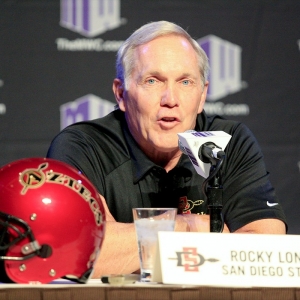
San Diego State head coach Rocky Long has the chance to make stats geeks and math nerds exceptionally happy this year if he follows through on his promises this season. For years people have claimed that punting is not an optimal decision. Instead, they would argue that gambling on fourth down would be the right move in almost every circumstance. Earlier this summer Long made news when he hinted that he was looking to punt a whole lot less this year. He wouldn’t go so far as to commit to a punt-free philosophy, and there is a long way to go from talking about it to actually doing it, but this is closer than any other coach in a college or pro program has come to making this happen, so it’s a start.
The reason why people get so excited about the possibility of never punting is simple — from a mathematical perspective it makes sense. In most cases the long-term expectations are higher from a fourth-down gamble than from a punt. When a team punts they are almost certainly giving up the ball, and they could give up more than that if they can’t cover the return. When they gamble they risk giving up bad field position depending on where they gamble form, but they also have a chance to continue their drive and improve their chances of putting points on the board. Over the long-term the benefit of those points will, mathematically at least, outweigh the downside of turning the ball over. In this era of explosive offenses that can creatively make gaining yards look easy, the argument is that the risk of the situation is even less.
When it comes to this debate, the unquestioned folk hero is Kevin Kelley. He’s the head coach of Pulaski Academy, a once-obscure high school program in Little Rock, Arkansas. Kelley refuses to punt — he has done it just three times in five years. He also onside kicks on every kickoff. In the last nine years that Kelley has embraced this philosophy he has won three state titles and scored points at a blistering pace. His approach has opened eyes and garnered a whole lot of coverage, but it hasn’t yet tempted a big-time coach to take a risk. But is it makes sense then why is that? Here are three of the many reasons:
Sample size is small
We’re not talking about a major difference between punting and not punting here. It’s not like a team that gambles will score 14 more points per game — at least not necessarily. We’re talking about fractions of points per punt. That can add up, and over time it could turn into extra wins. The problem is, though, that this is a small sample size we are dealing with. It’s rare for a team to face this situation 100 times in a year. That means that it would take a while for the benefits to be realized — teams might only see the equivalent of an extra win added to their bottom line every three years. A small sample size also means that the impacts of mistakes can be more significant, and that a negative streak could be particularly impactful.
Coaches like their jobs
Coaches are motivated by a lot of things, but near the top of that list is making sure that they keep their job. Winning is a big part of that, so gambling might be attractive on that front. The problem is, though, that staying out of the media and managing to not look like an idiot is even more important. The media has very little patience, and they don’t exactly grasp subtlety. That means that they won’t care if a gamble that doesn’t pay off was the right move over the long term. They will only focus on that one play that didn’t work and the impact that had in the short term — like a loss. That will have a damaging effect on job stability because the media will get the public fired up, and the public will let management hear their displeasure. In order for a coach to embrace this type of approach he’d need one of three things going for him. He’d need to have unquestioned job security, and that’s incredibly rare these days. Or he’d need to be seen as such a crazy, high-risk coach that this kind of thing that seems to make perfect sense for him. Or he’d just have to not care about keeping his job in the long term — and no coach feels that way.
No one is doing it
It would be much easier for a coach to embrace this if someone else was doing it. That way he’d have success to point at, and someone to blame when things went wrong. Being the first guy, though, is particularly scary for a coach, and it’s unlikely to happen in this current environment.
So, what is the impact for bettors of Long’s dalliance with statistics here? Well, that depends on how much he actually commits to it. There are some teams that quietly gamble quite a bit. Army, for example, gambled 34 times and punted 37. Coaches there didn’t take any grief about it — most people probably didn’t even notice. Long got more attention, though, by talking about it in advance. If he were to gamble two-thirds of the time or more — particularly in the opener against Washington because people will be paying attention to that matchup — then the story could gain real momentum. If that happens then the media coverage will drive betting attention, and value could be bet out of the team. If Long takes a slower and gradual experimentation approach, though, then he can do it without a lot of attention, and the betting impact of the situation will be minimal. Personally, I hope he fully embraces it and goes crazy, but I sadly don’t expect that to happen.
Most Recent College Football Handicapping
- NCAA Football Predictions: Week 14 Opening Line Report and Picks
- NCAA Football Predictions: Week 13 Opening Line Report and Picks
- 2025 College Football National Championship Futures Odds with Expert Betting Predictions
- College Football Playoff: Odds and Best Bets to Make 12-Team Field
- NCAA Football Predictions: Week 10 Opening Line Report and Picks
- NCAA Football Predictions: Week 9 Opening Line Report and Picks
- NCAA Football Predictions: Week 8 Opening Line Report and Picks
- NCAA Football Predictions: Week 6 Opening Line Report and Picks
- NCAA Football Predictions: Week 5 Opening Line Report and Picks
- NCAA Football Predictions: Week 4 Opening Line Report and Picks