
NFL Legends Who Ended Career with Wrong Team
Knowing when to walk away is tough for any football player in the NFL after so many years in the league. Guys who spend a decade or more with one team, making it their home in the process, rarely get to decide how it ends, and once that team moves on they take whatever offer shows up instead of sitting on a couch while everybody else suits up.
Front offices do not always give a guy the choice either, and a team can move on from a franchise player over money, age, or a roster spot it wants back. What comes next is usually a handful of games played in uniforms nobody wants to see, and a career that gets remembered for everything except how it actually ended. Let's look at six NFL legends who ended their careers on the wrong team.
Doc’s Sports offers NFL expert picks for every game on our NFL predictions page.
Johnny Unitas, San Diego Chargers (1973)
Seventeen years in Baltimore made Johnny Unitas arguably the ultimate quarterback of the late 1960s and a player any franchise would have wanted at some point, with three MVP awards and a championship with the Colts on the resume. Then Baltimore sold him to San Diego in 1973 for $150,000 in cash, and a 40-year-old with a shot elbow showed up to a franchise coming off three straight seasons without a winning record. You would think the trade was a steal for San Diego. Think again.
Unitas played just five games with seven interceptions on a 44% completion percentage, throwing for 471 yards and three touchdowns, and the Chargers benched him for rookie Dan Fouts before the season hit the halfway mark. San Diego finished 2-11-1 that year, which nobody was blaming Unitas for, though it did not make him look any better either.
The Chargers gained nothing from the deal, and Unitas himself later admitted the whole thing was a mistake. He never played another down after that year, and the Hall of Fame bust in Canton has him in a Colts helmet where he belongs.
Joe Namath, Los Angeles Rams (1977)
Guaranteeing a Super Bowl and delivering it is the kind of move that guarantees a quarterback love and respect forever, and Joe Namath had 12 years of it in New York. Once the Super Bowl high was long gone, though, the Jets waived him after the 1976 season when no team would trade for him. Los Angeles signed him the following May with the dream that Broadway Joe could finally push the Rams into the playoff picture.
Playing on knees that had been surgically rebuilt more times than anyone could count, Namath started four games and threw five interceptions against just three touchdown passes. The Rams won two of their first three, then a brutal Monday Night Football beating from the Chicago Bears in Week 4 ended his career for good. Namath threw four interceptions in that game, got pulled, and never took another snap in an NFL game.
Watching him struggle was hard enough for Jets fans, and watching him do it in a Rams uniform made it worse, since those four appearances turned out to be his entire second act.
Franco Harris, Seattle Seahawks (1984)
After winning four Super Bowl rings and being recognized for arguably the most famous play in league history, Franco Harris should have been in Pittsburgh for life. Money got in the way instead, with Harris asking for a raise heading into 1984 while sitting within reach of Jim Brown's all-time rushing record. Steelers management did not see the same vision Harris had in mind, decided he was finished, refused the raise, and released him during training camp when he threatened to hold out.
Seeing a guy who spent 12 years as the face of Steelers football pull on a Seahawks jersey never sat right with anybody, and the eight games he gave Seattle did not help the case either.
The total came to 170 rushing yards on 68 carries and zero touchdowns, which for a guy who had cleared 1,000 yards eight times and made nine straight Pro Bowls sounds like somebody was not keeping the stats right. The Seahawks cut him before the season even ended, and he finished a few hundred yards short of the record he was chasing.
Emmitt Smith, Arizona Cardinals (2003-04)
Passing Walter Payton for the all-time rushing record in 2002 should have been the perfect exit for Emmitt Smith, but the Dallas Cowboys went another route and released him that February. Arizona signed him the following month, handing a 34-year-old back the keys to an offense on a team that had not been relevant in over a decade. Big risk.
Smith did what any 34-year-old tailback could, putting up 1,193 yards and 11 touchdowns across 25 games over two seasons. A shoulder injury cost him six games in 2003, and the Cardinals went 4-12 and 6-10 with him in the backfield.
Nothing about it hurt the record book, since he still retired with 18,355 yards and 164 rushing touchdowns that nobody has come near. The images are the problem, because an entire generation now has two versions of Smith in their head, and one of them is wearing red.
Jerry Rice, Seattle Seahawks (2004)
After playing sixteen years in San Francisco, seeing Jerry Rice in the silver and black was an odd sight for any football fan, and yet he still made it work in Oakland, putting up a 1,200-yard season at age 40. Playing time dried up in 2004 though, and rather than accept a smaller role he asked out, which is how the greatest receiver who ever lived got traded to Seattle in the middle of a season.
Fast forward to eleven games in a Seahawks uniform, and Rice recorded just 25 catches for 362 yards and three touchdowns. Seattle lost in the wild card round, and that was the end of it on the field. He was already 42 years old by then, running routes on a roster full of guys who grew up watching his tapes, which is about as wrong as a Hall of Fame career can look on the way out.
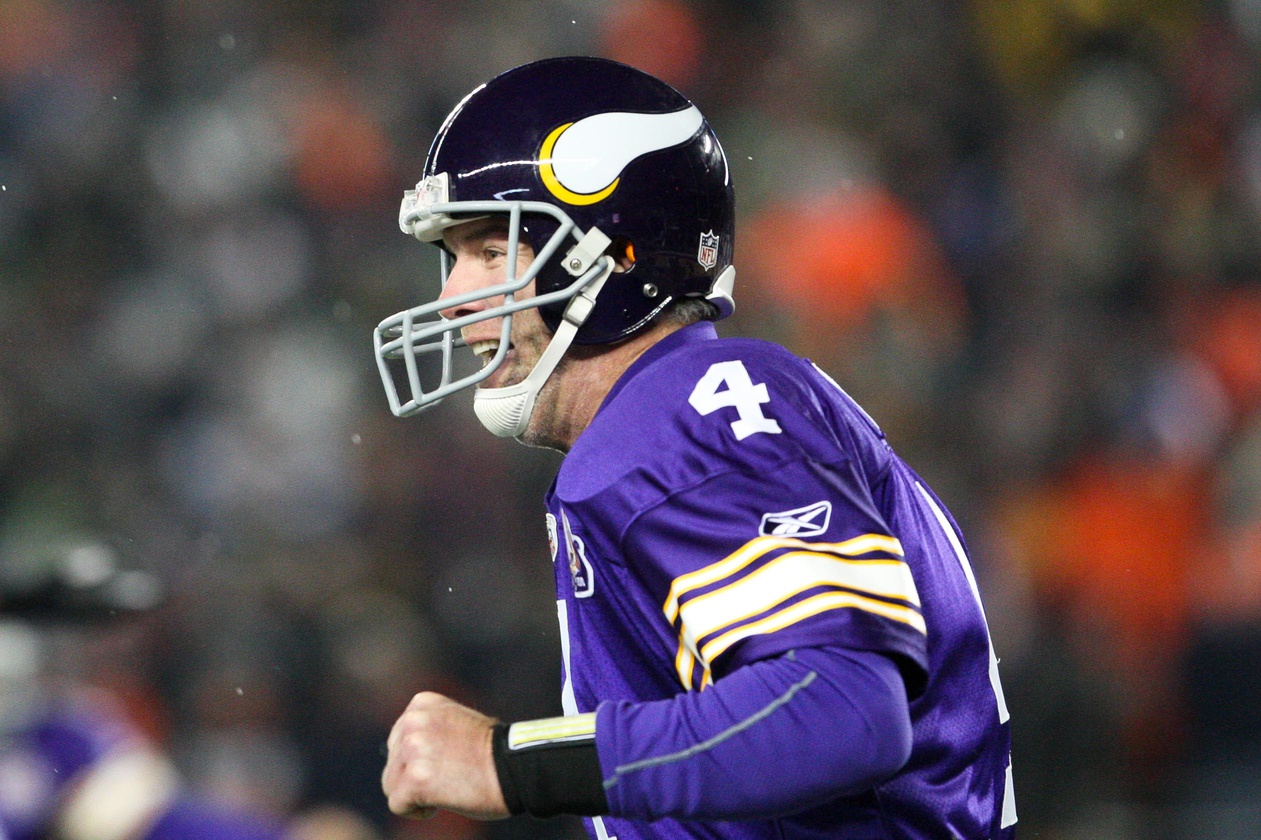
Brett Favre, Minnesota Vikings (2010)
Nothing in football hurts a fan base quite like watching the face of their franchise line up for their biggest rival, which is exactly what Green Bay experienced in 2009. After a messy divorce with the Packers and a single season with the Jets, Brett Favre landed in Minnesota at age 39.
That first year in 2009 almost made the gamble look worth it, as the Vikings went 12-4 and came within one interception of a Super Bowl berth. Coming back for 2010 is where time finally caught up to him. Minnesota stumbled to 6-10, Favre threw 19 interceptions with just 11 touchdowns, and his iconic 297-game consecutive starts streak finally snapped in December due to a shoulder injury.
Listen, Favre is still rightfully remembered as a Green Bay icon, a three-time MVP, and a Super Bowl champion. The final image of his playing career is the part people have not forgotten though, and it is a 41-year-old quarterback in a purple jersey.
Get NFL picks on every single game, or if you want our very best bets by the experts, sign up for your free $60 account with a guarantee.
Most Recent NFL Handicapping
- 65 NFL Financial Statistics for 2026
- Insane Weight Clauses and Fat Fines Written Into NFL Contracts
- Best NFL Teaser Bets Week 7: Basic Strategy Teasers Advice
- NFL Week 7 Line Movements with Point Spread Analysis
- NFL Betting Predictions: Week 7 Opening Line Report and Best Bets
- Best NFL Teaser Bets Week 6: Basic Strategy Teasers Advice
- Jalen Hurts Blood Clot Injury: Betting Impact for Philadelphia Eagles Week 6 and Beyond
- NFL Week 6 Line Movements with Point Spread Analysis
- NFL Betting Predictions: Week 6 Opening Line Report and Best Bets
- NFL Players Who Were Massively Underpaid for What They Produced